
It’s called tennis elbow, but anyone who performs an activity that makes them straighten and raise their hand repeatedly, either on the court or on the job, can end up with this painful condition. As chiropractors, we see a lot of tennis elbow (lateral epicondylitis). It’s a type of elbow tendonitis, similar to its less well-known cousins, golf elbow (medial epicondylitis) and pitcher’s elbow (epicondyle apophysitis)—the difference being the location in the elbow and structures affected. As with other types of tendonitis, chiropractic treatment can alleviate tennis elbow pain and help prevent it from returning.
Causes and Symptoms of Tennis Elbow
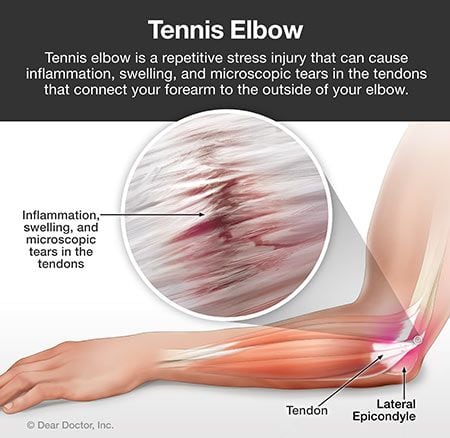
Tennis elbow develops when you repeatedly contract the muscles of your forearm to raise your hand and wrist, especially when combined with a gripping motion. This stresses the tendons that connect your forearm muscles to your elbow. The overuse causes tiny tears in the tendon where it connects to the bony part of the elbow on the outside of your arm and is accompanied by pain that may extend into your forearm and wrist.
Tennis elbow makes it hard to grip, so it can be difficult to do even simple tasks like shaking hands, turning a doorknob or even holding a mug. Your elbow may be sore or stiff in the morning and ache throughout the day. The pain is often worse when you’re gripping something due to inflammation of the tendon (tendonitis).
How Chiropractors Treat Tennis Elbow
Chiropractors have many ways to help alleviate the discomfort of tennis elbow without drugs, injections or surgery. Treatment may include adjustments along with a variety of other techniques to help you return to normal function, including:
- Muscle work: stretching, strengthening and removing knots
- Tissue repair: anti-inflammatory solutions such as low laser therapy or supplement recommendations
- Scar tissue and connective tissue work: including breaking up adhesions, which promotes faster healing by increasing blood flow to the area
Tennis Elbow Prevention Tips
Once we’ve helped with your tennis elbow, the goal is to keep it from coming back by stretching and strengthening your forearm and wrist. Here are some exercises that will help prevent recurrence:
- Do wrist extensions and flexes (move your wrist up and down) holding a small dumbbell or other weight.
- Clench and release your fist and wrist using a tennis ball or rolled-up towel to strengthen your grip. Do this up to four times a day for no more than three minutes at a time.
- Rotate your lower arm back and forth 20 times while holding a small weight, resting your hand on your knee. Try to keep the movement limited to your forearm so that you are exercising the large muscle affected by tennis elbow.
- Twist a rolled-up towel in a wringing motion, 10 times in one direction and 10 times in the other direction. This exercise can strengthen your wrist and restore mobility.
If you have symptoms of tennis elbow, chiropractic care can help. The condition doesn’t typically go away on its own, and it can get worse. We can help restore movement, lessen pain and get you back to your regular level of activity.