
If you’ve been on your phone a lot and you feel stiff or sore, you might have what we call “tech neck,” sometimes called “text neck.” Hunching over a smartphone, tablet or computer puts you into a posture that can stress your muscles and spine. Because many of us are on devices five or more hours a day, the incidence of tech neck is on the rise. As chiropractors, we’re specifically trained in biomechanics and how it affects your body.
Tech Neck Affects More Than Your Neck
In a neutral position, your head weighs about 12 pounds, so that’s the load your neck is carrying. When you tilt your head forward to look down at your phone, you’re increasing the load, which can become the equivalent of a 60-pound weight around your neck. No wonder things start to hurt.
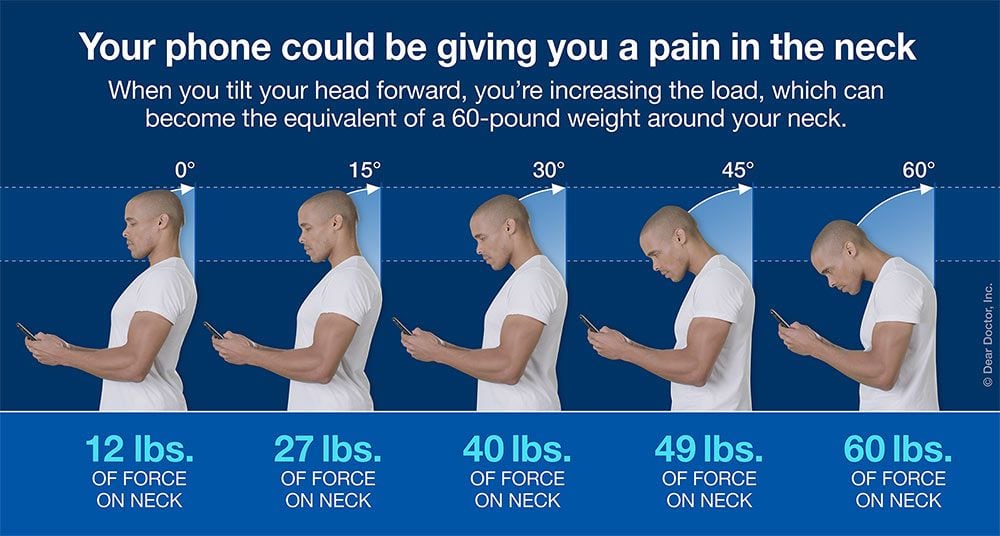
The head tilt also makes your spine move backward, and that makes your hips tilt forward. You end up with a misalignment, which puts pressure on your vertebrae, muscles and ligaments. Neck and shoulder stiffness or pain are the most common symptoms of tech neck, but it can also affect what is known as the entire kinetic chain in your body, involving your upper and lower back and the carpal tunnel in your wrist as well as being a common contributor to tension headaches.
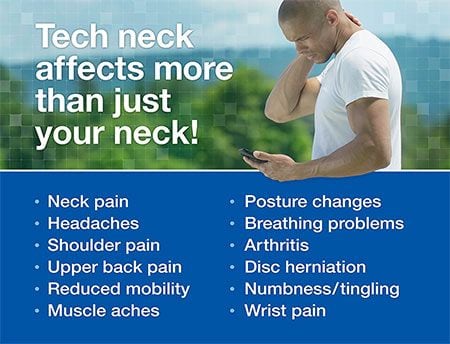
We know that tech neck can cause damage to the normal curve of the neck, which may result in arthritis. Some people develop numbness in their fingers, especially in their texting thumbs.
Over time, holding your head forward could lead to disc herniation, commonly called a slipped disc. Tech posture may even affect the amount of oxygen going to your muscles and brain since the leaned-over position decreases the space available for the chest cavity, resulting in less expansion of the lungs while breathing. According to one estimate, this forward-bent head posture could result in a loss of as much as 30% of the lungs’ capacity.
What Chiropractors—and You—Can Do About Tech Neck
Realigning the spine can relieve the pressure so that you feel better, but lifestyle and phone use modifications are key to reducing your risk for good. Here are some ways to help prevent tech neck:
- Hold your phone up in front of your face.
- Look down with your eyes, not your head.
- Take a break from tech work every 20 minutes or so, and stretch.
- Try a device holder, which lets your arms and shoulders relax.
- Keep your head in a neutral position, your wrists straight and your shoulders relaxed when you’re typing.
You can also do what chiropractors call “mirror exercises,” which counteract poor movement or posture. For instance:
- Lie on a bed with your head hanging off it for a few minutes, with a rolled towel or small yoga bolster under your neck.
- Shrug your shoulders up and down, focusing on pulling your shoulder blades down and back as you pull your shoulders away from your ears.
Tech neck is a 21st century affliction that may be here to stay, but you don’t have to be one of its sufferers. If you do have neck and shoulder stiffness, and you’re a heavy device user, make an appointment to come in for a visit. We can correct the misalignment, and regular visits can keep your spine functioning well. Meanwhile, you can begin to adopt good tech habits that will help keep you moving forward—and looking forward.